← All Xero reports
Built from your Xero data

Xero sales by customer report: who you invoiced and how much

A sales by customer report shows who your biggest customers are and how much each one bought in a period, such as last month. Xero doesn't have a report called sales by customer, but two of its reports come close, and they count slightly different things.

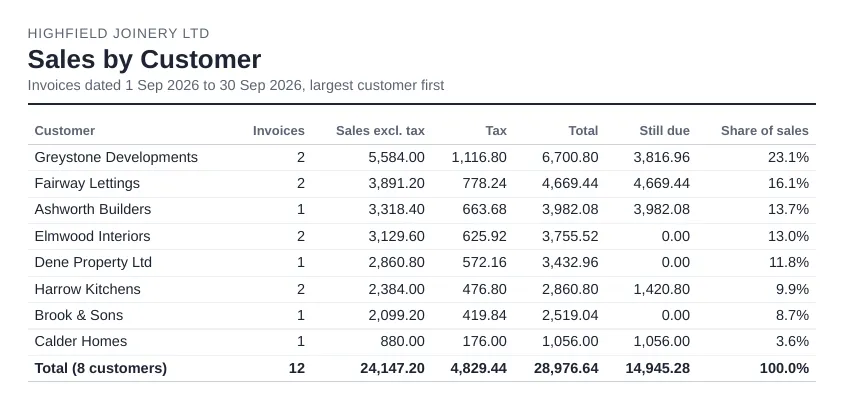
Sample Sales by Customer report for a demo company, as sent by Reportpost
A sample Sales by Customer for a demo company, as Reportpost sends it.

What it shows

  • Sales per customer for a period
  • In Reportpost's version, customers sorted largest first, with each one's share of total sales
  • Also in Reportpost's version: number of invoices (and credit notes, if any), tax, total and what's still due

A sales by customer list is also a quick concentration check. If one customer is a third of your sales, losing them would hurt, and a lender or buyer will ask about it. Seeing each customer's share every month makes that easy to watch.

Where to find it in Xero

The closest Xero report is Income by Contact, a ready-made format of the Income and Expenses by Contact report (open it from Reporting > All reports, then pick Income by Contact from the panel on the left). The Receivable Invoice Summary also has a Top customers format.

Settings worth knowing

  • Date range and comparison periods, to see each customer month by month
  • Filters by contact, contact group, account or transaction type
  • Mark it as a favourite if you use it often, or save it as a custom report once you've changed the layout

Things to watch out for

  • Income by Contact counts more than invoices: receive money transactions and prepayments are included too (credit notes are in both), so the total won't always match what you invoiced.
  • Amounts are net of tax and follow the invoice date, not when the customer paid.
  • You need the administrator, standard + reports or viewer role to run it.

Getting it by email on a schedule

Xero's standard report screens have no schedule option, so the usual routine is to export the report and attach it by hand. Reportpost sends a sales by customer table for your chosen period, such as last month: each customer's approved sales invoices less credit notes, excluding tax, with tax, total, what's still due as at the day it sends (less any unused credit) and their share of sales, largest first. If you invoice in more than one currency, each currency gets its own total. In the email, the report comes with a one-line summary: how many customers you invoiced, the total excluding tax and, if there's more than one, your largest customer with their share. You choose the recipients and how often the email goes out: weekly, every two weeks, monthly or quarterly, at the hour you pick in your timezone. Try the demo without connecting Xero.

Related: Which Xero customer report answers which question, Xero invoices raised report and Xero aged receivables summary.

Other Xero reports

Xero reportProfit and LossWhat the Xero Profit and Loss report shows, where to find it, the settings that matter (comparisons, tracking, cash or accrual) and how to email it every month.Xero reportBalance SheetWhat the Xero Balance Sheet report shows, where to find it, comparison and tracking options, and how to send it to directors or lenders each month.Xero reportAged Receivables SummaryWhat the Xero Aged Receivables Summary (aged debtors, or A/R aging report in the US) shows, how to read the ageing columns and how to get it emailed every week.Xero reportAged Payables SummaryWhat the Xero Aged Payables Summary (aged creditors, or A/P aging report in the US) shows, its ageing options and how to have it emailed before each payment run.Xero reportBank SummaryWhat the Xero Bank Summary report shows (cash received and spent per bank account), its options and gotchas, and how to send it automatically each week or month.Xero reportTrial BalanceWhere to find the Trial Balance in Xero, what it shows, its comparison and grouping options, the gotchas, and how to send it to your accountant at month end.Xero reportExecutive SummaryWhat the Xero Executive Summary includes (cash, profit, balance sheet and key ratios), its options and limits, and how to email it every month.Xero reportBudget SummaryXero's budget reports explained: what the Budget Summary shows, how it differs from Budget Variance, where budgets come from, and how to email it on a schedule.Xero reportBudget vs ActualHow to compare actuals with your budget in Xero (Budget Variance), what to look for, and how to have a budget vs actual report emailed every month.Built from your Xero dataCash Flow Statement (indirect)Xero only has a direct-method cash flow statement. How the indirect method works and how Reportpost builds one from your Xero data and emails it.Xero reportUnpaid InvoicesHow to get a list of unpaid invoices from Xero (Aged Receivables Detail), what it shows, and how to have the list emailed every week.Xero reportInvoices RaisedHow to list the invoices raised in a period in Xero (Receivable Invoice Summary or Detail), the options and gotchas, and how to email the list automatically.Xero reportDraft InvoicesHow to keep track of draft invoices in Xero, why they matter at month end, and how to have a list of drafts emailed to you so nothing is left unapproved.Built from your Xero dataRepeating InvoicesXero has no report of repeating invoices. How to see them in Xero, what a list should show, and how to have one emailed to you every month.Xero reportUnpaid BillsHow to get a list of unpaid bills from Xero (Aged Payables Detail), what it shows, and how to have the list emailed to you the day before each payment run.Built from your Xero dataRepeating BillsXero has no report of repeating bills. Where to find them in Xero, what a list should show, and how to have your regular costs emailed to you every month.

Let next month's pack send itself.

Reportpost emails your Xero reports on a schedule, as PDF, Excel or CSV. 14 days free.